As I'm transcribing the forms I know I'm finding that most turns are 90°. Therefore, new rule:
This will make things simpler by eliminating a bunch of redundant "90°" from various things.
As I'm transcribing the forms I know I'm finding that most turns are 90°. Therefore, new rule:
This will make things simpler by eliminating a bunch of redundant "90°" from various things.
Studio X, as I think I've mentioned before, doesn't have much in the way of written materials. Which, given the instructional methodology of the system, I'm beginning to think is a pretty bad idea.
A lot of the instruction of the lower ranks is done by upper-rank students. The format of a typical class is warm-up calisthenics, a little bit of sparring, and then beginning students are broken up into groups by rank and handed off to a black-belt for further instruction in that group's material. Which is a good system, at least in abstract, given the amount of material (rather a lot, IMHO) that students are expected to learn at each level.
The problem is that the quality of instruction varies immensely depending on which black-belt is doing the teaching. Some of them don't have a good grasp of the material; they teach forms/techniques by wrote and don't understand the application which underlies the techniques/forms. Which is partly just a matter of quality control; the chief instructor needs to be more discriminating in who is allowed to instruct.
Even with better controls in place, however, things are going to get mangled in transmission. I offer, as an example, the comments associated with my transcription of the rank 3 sparring techniques. Scav asked about Jade Ring stance, so when I had an opportunity I asked one of the student instructors about the stances used in technique #12. This instructor, a 2nd degree blackbelt who generally has an excellent understanding of the system, told me something which didn't seem quite right, so I asked the chief instructor about Jade Ring stance explicitly.
The long and the short is that the 2nd degree has been doing technique #12 wrong for years. That's a problem because martial arts systems aren't necessarily self-correcting; ey's transmitted a broken #12 to who knows how many students. The only reason I caught the mistake is that the chief instructor had previously shown me the technique and I care more about the details of execution than the average student.
From a practical standpoint this is nitpicking; the version of #12 which the 2nd degree showed me works fine. But each technique, especially in the lower rank material, (allegedly) has a specific reason for being included in the curriculum. This obviously holds true for #12; it's there to teach students how to get under a guard using Jade Ring Stance and an Upward Block. You don't get that if you do it the way the 2nd degree showed me.
So what to do about this? The simplest approach, it seems to me, is to just write things down, but that happens less frequently that it should; of the three systems in which I've studied only one had a decent manual. I think that's primarily a function of effort; the system which had a manual was a large, multi-studio affair, while the ones which didn't were small and mostly-independent. It takes a lot of work, as well as writing and organizational talent, to get material down on paper in a systematic fashion. However, if I were a chief instructor, and my concern was the reliable and efficient transmission of basic material, I would absolutely spend the time necessary to do so on the grounds that it would improve the quality of the studio.
As a secondary explanation, however, I believe there's also a unconscious bias, in some branches of the martial arts at least, in favor of strictly oral transmission. Historically a systems' techniques were viewed as trade secrets which were at risk of compromise if they were put down on paper. "Secret techniques" might have once had a place in a more militant era1, but they're unsuited to contemporary circumstances. If a student gets into a fight nowadays they're going to win because they understand basic concepts, not because they know the Five Point Palm. Which also argues in favor of writing things down in order to promote a solid understanding of the material.
I had to do some field transcription yesterday. We were having a special session to learn an "extra" form, one that isn't part of the canonical material for lower ranks. Since it was a one-time only affair I wanted to get it written down as quickly as possible to ensure that it wouldn't get lost.
Turns out that it's really convenient to do so using a clip-on pen and a piece of 8.5" x 11" paper. If you fold the paper into quarters it's stiff enough that you can write on it, plus each quarter is about the right width for use with the notation system. You can clip the pen to the paper and stuff the entire thing into the front of your gi (presuming you're wearing one, of course), which allows you to take notes on the spot without unduly disrupting things.
I wanted to get the world's thoughts on the stick-figure-ish diagrams I put together for the Rank 1 Blocks post. Way back in my original post on notation I discussed the limitations of photographs in this context, but didn't stop to consider whether those limitations applied to illustrations in general. Here are my observations in that regard after putting together the blocking diagrams:
In general I found it nigh impossible to describe blocking techniques using English only; the addition of the diagrams helps eliminate the ambiguities which crop up in the written word. I also like the ability to annotate the diagrams with motion/momentum arrows. Again, this is technically possible with photos, but much more difficult.
So, thoughts? Should I gin up some more diagrams for punches/kicks?
Studio X doesn't really have a systematized blocking system. Or, rather, they do, but they don't teach it as such. Instead, blocks just show up in forms/techniques and the student does them through imitation. In this regard they get less emphasis that punches/kicks since those are explicitly taught in a stand-alone fashion. I consider this to be a shortcoming of the system; learning how to block correctly is no less important than learning how to punch or kick. This post is the beginning of an attempt to record all of the blocks used withing Studio X in a systematic fashion. Since they aren't taught formally the material which follows is based largely on my own observations and previous experience in other systems.
The Rank 1 blocks can be loosely (and I emphasize the word "loosely") classified as "hard" or "soft":
The hard blocks oppose force with force and include the "inward/outward/upward/downward" set that I first learned a long time ago as a white belt in a karate-based system. The soft blocks don't oppose the force of incoming strikes directly but instead seek to deflect/redirect the strikes away from the defender; in this fashion they're much like the blocking techniques I learned as a beginning 7-Star Mantis student. I don't have a sense at this point as to how this division holds up as the student progresses; I've seen both types of blocks in the additional material to which I've been exposed.

This is the first block which students encounter and is ubiquitous within the Studio X system. It is intended to intercept a chest-/face-level punch and redirect it over the defender's shoulder. As the punch (represented by the green arrows) comes in the back/outer edge of the defender's hand/wrist (highlighted in red) makes contact with the attacker's wrist, pulling it up and away from the center line.
This block is usually paired with a counter-punch (reverse or horizontal) executed more-or-less simultaneously by the opposite hand.
This strikes me as a very difficult block from a technical standpoint. Being able to intercept and redirect a punch coming at anything approaching full speed requires good reflexes. Additionally, this block makes use of muscles in the shoulder which are difficult to condition effectively without the use of a weight machine. Which makes me wonder a) why they teach this as the first block and b) how many students can actually execute the block effectively?

The inward block is similar to the intercepting block in that it is designed to redirect a linear strike aimed at the chest/head. The blocking arm comes up and back, as shown in the above illustration, and then sweeps down/across the chest, intercepting and deflecting the incoming strike with the edge of the forearm (highlighted in red).
This block is much easier to execute than the intercepting block for several reasons. It travels towards the center line powered by the action of the pecs/lats, muscles which are generally in better shape than those of the shoulder. Additionally, the blocking surface is larger and the necessary range of motion smaller, which means that this block is generally more forgiving of errors in timing and accuracy.
However, and this may be the reason why the intercepting block is favored by Studio X even though it is more difficult to pull off, the fact that the inward block crosses the center line makes it difficult to throw a simultaneous counter punch. The blocking arm gets in the way, as does a successfully-deflected strike, and any potential counter needs to overcome the angular momentum generated by the blocking process.
This block is often used in conjunction with an outward block executed by the opposite hand to clear and position the attackers arm prior to the application of a monkey grab.

The outward block, like the inward block, is intended to deflect a linear strike aimed at the chest/head. The forearm starts at roughly the level of the sternum, parallel to the ground and 8-ish inches away from the chest. It then pivots around the elbow, catching the strike on the edge of the forearm (denoted in red in the diagram) and pushing it away from the center line. The range of motion is such that the forearm/fist should just exceed the shoulder; any less means you're going to get tagged in the shoulder by the strike, any more is unnecessary effort.
The astute observer will notice that this block serves roughly the same purpose as the intercepting block, which raises the question of when you'd use one vs. the other? Based purely on my own experience I'd say it depends primarily on where's the closest bit of empty space relative to the incoming strike. If a strike is coming towards your face there's greater economy of motion in deflecting it over the shoulder (i.e. an intercepting block), whereas if its coming at the sternum its faster to deflect it to the side (an outward block).

The outward block is often used in combination with others strikes/blocks. As mentioned above, it is commonly used in conjunction with an inward block to clear a strike and setup for a grappling/chin-na technique. In this application the defender executes an inward block to catch the incoming strike, followed half-a-second or so later by an outward block. When performed correctly the two blocks mesh together; as the inward block pushes the strike towards the opposite shoulder the outward block sweeps up and skims along the outside of the opposite forearm, smoothly continuing the redirection. The outward block can then be turned into a grab by opening the hand and rotating/sliding the palm outward until it engages the attacker's arm.
Like the intercepting block it also leaves you in a natural position to throw a simultaneous counter punch, usually a horizontal punch.
Now, interestingly, there's a good case to be made that this block doesn't work as advertised. The shoulder muscles which power and stabilize this block (the teres major/minor I believe) are difficult to condition without the use of specialized equipment and, as such, aren't necessarily well-developed even in a relatively-skilled martial artist. In order to make the block remotely effective you've got to root yourself and really turn your hips/torso into it as well.
This might be taken as carping on my part, to which I'll respond that this isn't an original observation. It was first brought to my attention by a friend of mine who's a 4th dan in a system which teaches this block as part of the basic White Belt material. The way he put it was "If I can't do it after 15 years maybe its the block, not me".
As to why it's still hanging around? Tradition and lack of testing would be my guess. The mechanics of the block are plausible enough provided that you don't have to deploy it against a full-speed, full-force strike. Additionally there are situations, such as the inward/outward combo discussed above, where it does have utility. Who's going to drop the block from the official corpus given such considerations?

This is a simple block that is used to counter an overhead strike. The forearm is raised above the head and braced via the triceps/shoulder, applying a directly opposing force to whatever strike might be incoming. Note that the forearm is 15° or 20° from parallel with the ground; this encourages the incoming strike to slide off to the side, reducing the total force necessary to neutralize the blow. Two caveats to remember w.r.t positioning of the forearm which aren't adequately conveyed by the illustration:

A natural reaction to having someone throw a kick at you is to try to block it with your forearm; it's a reflex I've seen any number of beginning students. Of course, they generally do it wrong: they lean over, they block with the wrong part of the forearm, etc. The downward block is simply this basic, defensive instinct given an effective form and execution.
In order to deflect a rising kick along the center line the defender first makes a fist, palm towards the chest, and brings it across to the opposite side of the body with the forearm roughly parallel to the ground. The forearm then sweeps down across the body, catching the incoming kick (ideally just above the ankle) on its leading edge and deflecting it away from the center line. It's important to leave a fair amount of distance between the forearm and the rest of the body so that there's sufficient time to deflect the block before it makes contact. The motion is complete when the wrist/forearm just exceed the knee.

A downward block can also be used to counter a circular kick such as a roundhouse. In this situation the motion is the same but the defender's forearm and the attacker's leg come into contact after the forearm has exceeded the torso/leg. The forearm is angled in such a fashion as to directly oppose the motion of the kick, neutralizing it if all goes well. My experience is that this variant is easy to execute but will leave nasty bruises; I prefer to drop elbows instead if possible.
Th downward palm block (called the "downward pressing palm" in another system I've studied) is mechanically simple, easy to execute, and tremendously useful. It's a very strong block, being braced by the triceps/pecs, and so can be used to directly oppose a rising kick. At the same time the defender has a lot of fine control over its execution and so can use it to deflect a horizontal strike.

When blocking a rising strike/kick the defender positions their hand along their center line, 8-ish inches away from their body, palm down and parallel to their chest. They then push down vigorously while maintaining the hand's orientation, neutralizing the incoming strike via the application of directly opposing force.

When deflecting a horizontal strike the blocking hand starts well away from the body, around the level of the sternum and a little off the center line. The idea with this variation of the block is to match the speed and trajectory of the incoming strike as closely as possible, bringing the blocking hand in towards the torso and center line while simultaneously pushing down. This will redirect/dissipate the strike's momentum; in the best-case scenario the defender ends up momentarily trapping the striking limb, leaving the attacker wide open for a counter with the opposite hand.
Two bad habits that I've noticed of myself when making use of the block:

The inward palm block is used to deflect a linear strike to the area between the sternum and navel. The forearm starts (mostly) parallel to the ground with the hand held near the lower ribs, palm facing inward and perpendicular to the ground. The defender then pushes the palm across the lower abdomen, intercepting and redirecting the incoming strike.
I'm not entirely sure why this block exists; it's not something I find myself executing naturally. I generally prefer to drop elbows or use some variant of a downward pressing palm. One thing that I've noted, however, is that this block shows up almost exclusively in combination with an upward block executed by the opposite hand, which suggests that there might be some subtle, mechanical reason for the pairing. Dropping an elbow when one arm is already committed to an upward block is certainly awkward, but using a pressing palm seems natural since the application of downward force nicely opposes the force of the upward block. This is something that I'll have to ask about.

This block is fairly simple, executed by bringing the arms together and down to oppose a rising strike. But as I was putting the above illustration together I realized that I don't have a great grasp of when, and against what sorts of attacks, it would actually be used. There are some techniques where its executed directly on center and others where its executed at 45° off the center line; the types of attacks that it can counter differ in each case. I've also had at least one person describe this block to me in a way which makes me think its a stand-in for a couple of different techniques.
What I believe is going on, based on other elements of the system to which I've been exposed, is that the "double downward block" that shows up in various techinques is a stand-in for the following:
The first of these would be most effective against a rising kick delivered along the center line, while the second and third would, when executed 45° from center, be effective against circular strikes/kicks.
Note that there is also a one-sided (i.e. single handed) version of this block that is mostly used to protect the groin when executing mid- and high-kicks; I'll refer to this variant as a Downward Backfist Block.
#11
                RP
DFB
SS
#12
                RP
JRS UB
                RP
DFB
SS
#13
                DBB SK
                VP
VP
                VP
OB
SS
#14
SS
        ↑
                VP
VP
                VP
OB              SS
        ↑
                SK DBB
                STK→
                CS
        ↓
                SS
#15
                DBB SK
                VP
VP
                VP
SS OB
        ↺180°
↓STK
                SS
        ↺180° IS
SS
In which I lay out some preliminary ideas regarding the specification of targets.
I've reached the point where I need to transcribe some things which don't make sense without a way to denote a target, which means that it's probably time for us to tackle targeting notation. Rather than being a discussion of what bits of the human body make an effective target, which I've done a little bit of work on in the past (1, 2, 3, 4), this is going to focus on how to describe where on the body a blow should be aimed. Additionally, I'm going to set aside considerations of concrete notation for the moment and consider how we might specify a target from a more theoretical standpoint.
The other day, when I was asking an instructor "Where is this directed?", he answered "Oh, probably 23 and 24", referring to Ren Meridian points 23 and 241. Which got me thinking about using acupuncture points as the basis for a general targeting system.
Acupuncture points have some properties which would make them useful for the purposes of targeting: they're standardized (more or less), widely known, and each ones specifies a very specific bit of the human anatomy. Counter to this, however, are the following drawbacks:
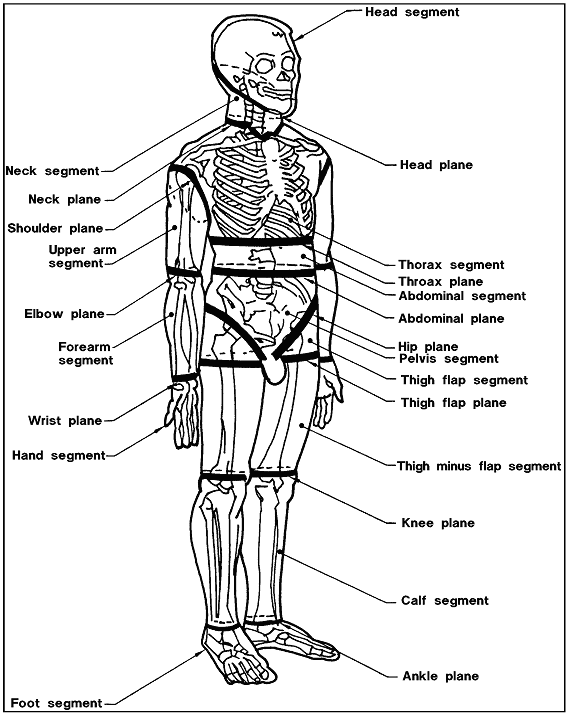
With regards to item 1, we want whatever targeting system we adopt to be lower resolution than the meridian system. It seems to me that a natural way to accomplish this would be to move away from conceptualizing targets as specific points and towards imagining them as two-dimensional areas. Adopting such an approach would also reduce (considerably vs. the meridian system) the number of items which have to be memorized, thus promoting general ease-of-use.
Building a system from the ground up, however, should be avoided if possible. Not only are we reinventing the wheel but it prevents us from partaking of any of the benefits of the meridian system such as standardization and distribution. So, I then asks myself, are there any pre-existing systems which have the properties we're looking for?
NASA didn't invent the terminology, but they're real good at making it accessible to non-medical types (like us dumb engineers). I like "Figure 3.1.2-5 Illustrative view of Body Segments and Planes of Segmentation in particular because it approximates (mostly) how I mentally divide the body into regions for the purposes of targeting.
Now, some questions for discussion:
So here's what I propose:
How does that sound?